
ADHD vs Autism: What’s the Difference?
(and when do they overlap?)
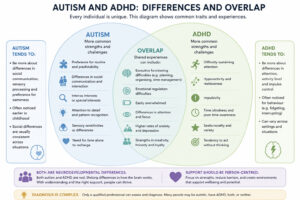
ADHD and autism are often talked about together—and for good reason.
They can look similar in some ways, overlap in others, and frequently co-occur.
But they are not the same thing.
The Core Difference (In Simple Terms)
At a broad level:
- ADHD is primarily about regulation—of attention, activity, and impulses
- Autism is primarily about differences in social communication and processing the world
That said, real life is rarely that neat.
Where ADHD Shows Up
Adults with ADHD often describe:
- Difficulty sustaining attention (unless something is highly engaging)
- Disorganisation and forgetfulness
- Acting or speaking impulsively
- Struggles with time management
There’s often a sense of:
“I know what I need to do—I just can’t consistently do it.”
Where Autism Shows Up
Autistic adults may experience:
- Differences in social interaction (reading cues, small talk, unspoken rules)
- A preference for predictability and routine
- Intense or focused interests
- Sensory sensitivities (noise, light, textures)
There’s often a sense of:
“The world feels overwhelming or confusing in ways I can’t explain.”
Where They Overlap
This is where it gets more complex.
Both ADHD and autism can involve:
- Executive functioning difficulties
- Emotional regulation challenges
- Sensory sensitivities
- Feeling “out of step” with others
This overlap is why some people relate strongly to both.
Can You Have Both?
Yes—very commonly, there is a substantial overlap.
Research and clinical experience both show a significant overlap between ADHD and autism.
When someone has both, it can look like:
- A need for routine (autism) but difficulty maintaining it (ADHD)
- Deep interests (autism) that shift or scatter (ADHD)
- Social fatigue combined with impulsive communication
Why Getting the Right Assessment Matters
Because of the overlap, it’s easy to:
- Miss one condition
- Or misattribute difficulties to the other
A good assessment takes a step back and asks:
- What best explains this person’s overall pattern?
- Is there one condition, or more than one at play?
Final Thought
You don’t need to figure this out on your own.
If you recognise yourself in parts of both ADHD and autism, that’s not unusual—and it’s not a contradiction.
It’s simply a sign that your experience deserves a careful, thoughtful understanding.
There is a lot of information available to explore this further, for example on the Autistica and National Autistic Society websites:
https://www.autistica.org.uk/what-is-autism/adhd-and-autism
https://www.autism.org.uk/advice-and-guidance/related-conditions/related-conditions/all-audiences